A simple and useful video with MLA formatting basics:
How to format your essay using MLA Style
Works Cited: Quick Guide
https://style.mla.org/works-cited-a-quick-guide/
A simple and useful video with MLA formatting basics:
Works Cited: Quick Guide
https://style.mla.org/works-cited-a-quick-guide/
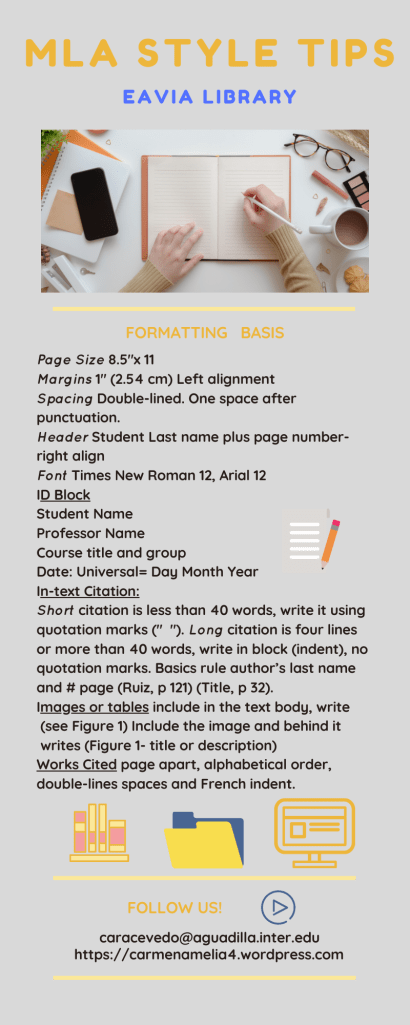
MLA 8th edition format establish a rules to write a essay using the same recommendations to each document, I adapted a guide to 7th – 10th grade EAVIA’s students.
Use the citations to avoid plagiarism and present the Works Cited. Practice with the worksheet above.
Ask your librarian for help using the the comments space or the e-mail: caracevedo@aguadilla.inter.edu of Jupiter Ed account.
Follow the instructions and success in your task.





7th-12th grade workshop
Parts of a book:
Adapted by Mrs. CA Acevedo from: Different parts of the book and their meaning. https://bestbooksandauthors.wordpress.com/2013/08/08/different-parts-of-the-books-and-their-meaning-best-selling-books/

A curious meaning:
THERE’S A WORD FOR THIS?! The etymology of the word is hard to pin down, but most claim it to be a made up of its Latin parts: Liber, meaning book, and cubiculum, meaning bedroom. It was first used, it is thought, in 1921 by Christopher Morley in his book, Haunted Bookshop. It also appears to have been an answer to a question in the 1981 genius edition of Trivial Pursuit. (Tara Curley,2014)
Infographic by gosiarisuje.pl


https://www.nasa.gov/open/researchaccess
«NASA has developed an agency plan, and associated policy, outlining a framework for activities to increase public access to scientific publications and digital scientific data resulting from NASA-funded research.»
En la actualidad la cantidad de información que encotramos en el Internet es inmensa nos toca poder decidir cúal es la necesaria, por esta razón debemos aprender a evaluarla y ser asertivos.
La siguiente presentación y video le ayudará para poder lograr ser ciudadanos digitales responsables y obtener el máximo provecho de los recursos encontrados en la red.
Today the amount of information that we find on the Internet is immense, we have to decide which is necessary, for this reason we must learn to evaluate it and be assertive. The following presentation and video will help you to become responsible digital citizens and get the most out of the resources found on the web.
Buscador Safe Search Kids: buscador creado por Google donde se dirige a los niños a una búsqueda educativa.
Buscador KidRex:http://www.kidrex.org/ Este buscador es altamente recomendado porque es especializado para estudiantes de escuela elemental e intermedia. El mismo localiza direcciones dónde aparecerá información educativa relacionada a lo solicitado. Enciclopedias
Diccionarios
http://rae.es – Diccionario de la Real Academia Española
www.wordreference.com – Diccionario
.www.sinonimos.org –Diccionario de sinónimos.
Generales
http://www.infoplease.com/ – Almanac, Dictionary, Encyclopedia, Atlas and Biographies
http://www.biography.com/ – Biographies
www.biografiasyvidas.com – Biografías y vidas
www.buscabiografias.com/bios – Buscabiografías
www.ellibrototal.com –Biblioteca digital.
www.rinconmaestro.es -Portafolios digitales de diferentes temas y materias educativas.
www.ncwiseowl.org/ – red social enfoque educativo
http://www.snopes.com buscador para corroborar información
Periódicos
http://www.nytimes.com/ – Periódicos de los Estados Unidos y de la ciudad de Nueva York.
https://www.washingtonpost.com/- Periódicos de los Estados Unidos y de la ciudad de Washington.
http://edition.cnn.com– Periódicos sobre el mundo.
Science
https://www.sciencebuddies.org/ Hands-on Science Resources for Home or School
http://www.education.com/science-fair/ Science Fair Projects
http://index.about.com/index?q=science+fair&o=40026&qo=aboutSiteSearch&ad=dirN Science Fair Projects
http://science.yourdictionary.com/ Definitions.http://redsismica.uprm.edu/Spanish/- datos sobre lo que ocurre diariamente en nuestras placas tectónicas– Red Sísmicahttp://www.srh.noaa.gov/sju/es/index.php- Noticias sobre el clima en Puerto Rico y en el Caribe.www.pinakes.org Para desarrollar investigaciones enfocadas en la herencia científica.
www.windows.ucar.edu/spanish.html Incluye imágenes, películas, animaciones y series de datos, que exploran las ciencias de la tierra y del espacio, así como los lazos históricos y culturales entre ciencias, exploración y la experiencia humana. Debido a usuarios de todas las edades, el Portal está escrito en tres niveles de lectura, primaria, media y secundaria.
www.forests.org Noticias, información y recomendaciones para la protección de los bosques.
http://world-biomes.softonic.com/mac Para descargar programa interactivo sobre libro de biomas.
https://www.pbs.org/show/serving-science/ Science Serving= Food and Scienc
www.ngenespanol.com –National Geographic en español
www.faunaiberica.org -Animales de España y Portugal
www.nasa.gov –Página oficial de la NASA.
www.acienciasgalilei.com –Matemáticas, física, química y el espacio.
www.volcanolive.com –Fotos de volcanes y información sobre ellos.
www.portalciencia.net –Pagina de astronomía, paleontología, antropología, etc
www.astromia.com -Todo acerca astronomía.
www.srh.noaa.gov -Servicio nacional del clima.
www.edenorchicos.com.ar -Juegos educativos para niños.
www.solarviews.com –Sistema solar.
www.fisicanet.com.ar –Todo acerca de las ciencias.
English web recommendations:
ipl.org Internet public library– servicio de referencia, área de lectura, periódicos, revistas, espacio para niños y adolescentes, colecciones especiales.
infoplease.com Referencia, Spelling Bee, cool stuff, centro de ayuda para asignaciones.
kartoo.com La búsqueda de enlaces lo presenta por medio de mapas conceptuales.
http://www.schooltube.com/ Acceso a videos educativos.
sparknotes.com Guía literaria.
dogpile.com Metabuscador de infospace- Google, YouTube, Yahoo! Search, live search, Ask.com, About, MIVA, LookSmart y otros.
metacrawler.com Metabuscardor- Google, Yahoo! Search, Ask Jeeves, About, MIVA< LookSmart y otros. Accede la información en el idioma que la solicites.
http://www.timeforkids.com Revista con información actualizada para niños.
Art
Revistas en línea:
http://scielo.org/php/index.php?lang=en Open Source- journals
www.ipl.org Internet Public Library
Literatura e información para español
Obras y autores
http://www.sololiteratura.com/litpuertorico.htm
http://www.rinconcastellano.com/
http://www.cervantesvirtual.com/
Historia Literaria de Puerto Rico
http://www.uhu.es/antonia.dominguez/pricans/historia_literaria_de_puerto_rico.htm
Marco socio cultural de la creación literaria
http://ntic.educacion.es/w3//eos/MaterialesEducativos/mem/aventlitera/html/marco/marco.html
Historia- «Wonders and site»
http://www.theworldwonders.com/
http://www.mapsofworld.com/wonders-of-world/top-100.html
http://www.sacred-destinations.com/categories/cathedrals
http://video.pbs.org/video/1619317222/
http://www.world-archaeology.com/category/great-discoveries/
http://izismile.com/2012/03/07/the_worlds_most_beautiful_places_33_pics.html 33 Most Beautiful Places in the
Luego de escuchar el Podcast del cuento Coronavirus ilustra una de las practicas que debes realizar para evitar contagiarte con el Coronavirus (COVID-19). Envia la ilustración por correo: caracevedo@aguadilla.inter.edu o por la cuenta de Jupiter Ed. Así serás el ilustrador de este cuento. Te felicito y te invito a escuchar otros cuentos.
Saludos de Mrs. Amelia, tu bibliotecaria en línea.
https://hostingfacts.com/evaluating-online-resources/#Checklist
Today access information is really quite easy, the complicated is to recognize the valid information, if it is credible, or a post-truth, is a disinformation or misinformation.
Online resources have some several documents with suggestions to guide yourself and access reliable information. Read this document and the info-graphic, them may help you to present your task using the valid information to create an excellent assignment as a responsible communicator.

Source:
The Complete Guide to Evaluating Online Resources. (2019). https://hostingfacts.com/evaluating-online-resources/

